
Photo © Jean-Claude Djian
On July 19, the Greenwich Trio captivated the audience at the Festival Hier & Aujourd’hui with a bold and contrasting program. From the rigor of Bach to the romantic depth of Brahms, through the modern sounds of the German composer Wolfgang Rihm.
July 19, Parc du Château de Marolles at 6:00 PM — the audience gathers to share a drink and exchange impressions. Tonight’s concert by the Greenwich Trio is eagerly awaited, as the ensemble is internationally renowned.
Formed in 2006, the Greenwich Trio is the recipient of prestigious awards such as the Solti Foundation, the Tunnell Trust Award, and the Beethoven Society of Europe Competition. Their trajectory includes invitations to renowned international festivals: Santander, Rheingau, Ljubljana, Bath, among others. Their recordings of the Brahms Trios (Linn Records) received five stars from BBC Music Magazine.
For its 5th edition, the Hier & Aujourd’hui Festival, organized by the Adour Association, chose to hold its programming under the metal structure of a hall designed by Gustave Eiffel. A subtle tension arises in the gentle night of Touraine; the hall comes alive, the light dims gradually, softened by spotlights aimed at the stage. Right at 7:30 PM, the audience heads under the hall, which fills with a solemn yet convivial atmosphere.

Lana Trotovšek Photo © Jean-Claude Djian
Excerpt from the Chaconne of Bach’s Partita No. 2 in D minor
Solo violin: Where the Past Meets Modernity
Lana Trotovšek enters the stage. The Slovenian violinist, with an international career, performs Bach’s Chaconne from Partita No. 2 in D minor. This demanding piece, written for solo violin, is a monument of the Baroque repertoire. The artist crafts a rigorous sonic architecture—each variation reveals a different emotion, tinged with gravity, fervor, and nostalgia. It is a technical and expressive feat, where the past encounters modernity.
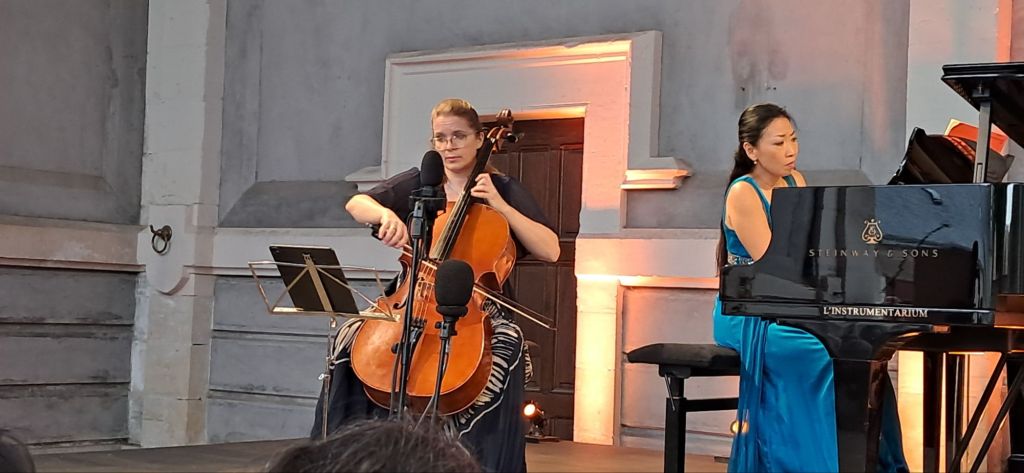
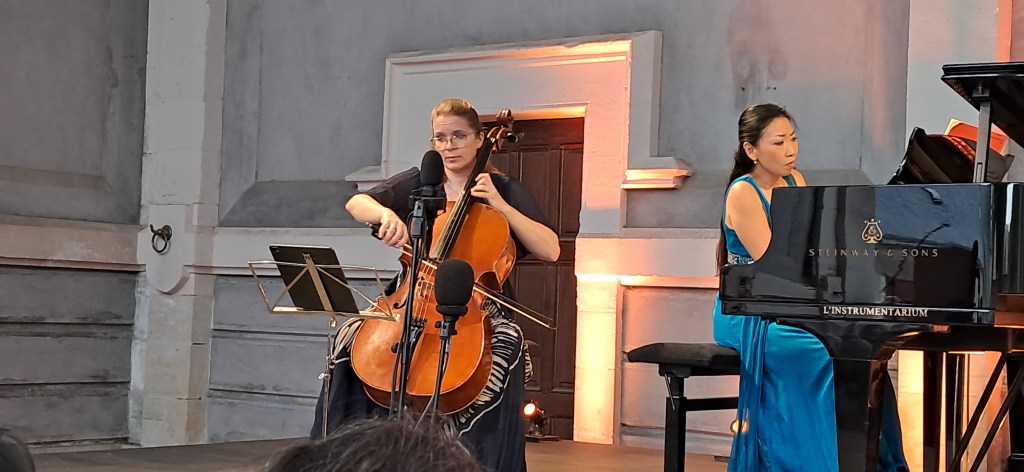
Heather Tuach & Yoko Misumi Photo©Jean-Claude Djian
Excerpt from Brahms’s Sonata No. 2 in F Major, Op. 99
Musical Exchange between Piano and Cello
Next on stage is Japanese pianist Yoko Misumi, accompanied by Canadian cellist Heather Tuach. The duo performs Brahms’s Sonata No. 2 in F Major, Op. 99. This dialogue between piano and cello is marked by restrained romantic intensity, blending tenderness and depth—a true musical exchange.

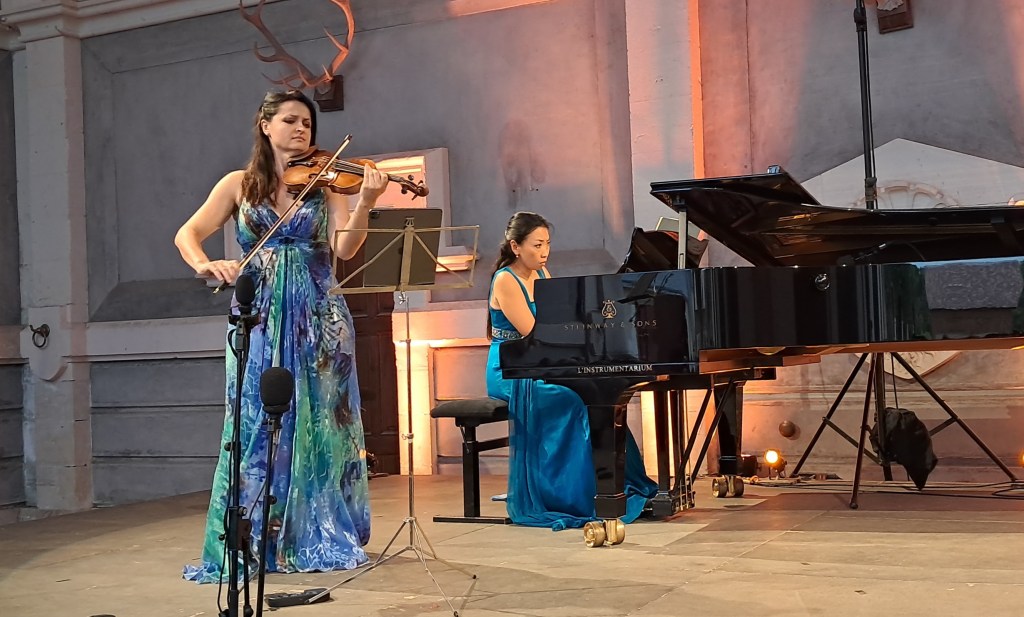
Yoko Misumi & Lana Trotovšek Photo © Jean-Claude Djian
Excerpt from Brahms’s Sonata No. 3 in D minor, Op. 108
Piano-Violin: Between Heroic Gestures and Subtle Melancholy
The cello gives way to the violin as Lana Trotovšek and Yoko Misumi team up for Brahms’s Sonata No. 3 in D minor, Op. 108. This intense, contrasting work demands much from both performers: lyricism, dramatic energy, nostalgia. Lana Trotovšek, on her 1750 Treviso violin, produces a warm and poetic sound. Yoko Misumi responds attentively, with precision and passion. Their duo expands the sonic universe—tension, heroic gestures, subtle melancholy. Their chemistry is palpable.
The Trio: All about Contrasts
Finally, the trio reunites to close the evening with a contemporary work, Fremde Szene III, by German composer Wolfgang Rihm. The piece, marked by interruptions, silences, raw and introspective atmospheres, demands complete cohesion among the three artists. Together, they plunge the audience into a fragmented, almost cinematic soundscape. The contrasts are striking, the passages intensely rarefied. More united than ever, the trio displays uncommon confidence in tackling demanding contemporary music. When the final chord fades after Fremde Szene III, the audience gives the trio a warm ovation. There is a sense of having witnessed a rare moment: a concert in which every note was thoughtful, heartfelt, shared, demanding, alive.

The Greenwich Trio – Photo © Jean-Claude Djian
Interview with Heather Tuach, Yoko Misumi and Lana Trotovšek
One Trio, Three Soloists, One Shared Story The three musicians live in London and meet regularly to rehearse when they have no other artistic commitments. For them, playing together is a unique experience.
“We truly enjoy playing together. It brings us real joy to be the three of us on stage. Playing as a trio is our passion,” says Heather Tuach.
“Performing as three in concert is like blending together. When one of us tries something new, it surprises us, but above all, it delights us.”
“The important thing when playing together is listening to each other. Communication is essential and it comes naturally to us,” Lana Trotovšek adds. “With our instruments, sometimes we sing, sometimes we talk among ourselves. Making music is like making love beyond the clouds.”
Interview with Pascaline Ponti, Production Manager of Hier & Aujourd’hui Festival
The Spirit of the Hier & Aujourd’hui Festival Embodied
The Hier & Aujourd’hui Festival is an act of transmission: it allows the wider public, in a friendly setting, to experience the contrast of musical eras. One realizes that new music can converse with the great works of the past.
“We don’t work in a very orthodox way. We suggest programs to the artists,” explains Pascaline Ponti. “That’s been our credo since the festival’s inception. With Xenakis’s ‘Kassandra’ and Bach, we balance two times coming together. When you hear Rihm’s piece tonight, you sense its connection to Beethoven. For the artists, contemporary and classical repertoires have a different sound and sharpness. They listen closely. There’s an almost spiritual, personal quest for sound. Whether it’s Xenakis, Rihm, or Monteverdi, for us, there are no boundaries—only musical gestures.”
The program was designed to provoke, fascinate, and move. The festival doesn’t just present a concert; it tells a story of musical contrast and complementarity. Since its founding in 2021, the Adour Association has sought to bring together major works from the classical repertoire and contemporary creations in a single event, to break from the notion that novelty and tradition are opposed. By proposing works by Bach, Brahms, and Rihm in a single program, the Greenwich Trio fully embodies the festival’s mission—bringing meaning to the temporal loop between past and present.
The Greenwich Trio gave the Hier & Aujourd’hui Festival a remarkable evening under the Gustave Eiffel hall at Château de Marolles, in Genillé. A bold program, ranging from Bach and Brahms to Rihm, performed by three exceptional musicians. An exacting, moving performance, conceived as a narrative path—from solo works to contemporary creation—illustrating the primary aim of the festival: to make the dialogue between music of yesterday and today resonate. For the audience, it was an immersion in the world of chamber music: both accessible and refined, rooted in tradition, and open to the present. A true ode to living music, to be shared and relived.
Discover Greenwich Trio on their latest album
Brahms Piano Trios Vol. 1 No. 2 in C major, Op 36 & 87 – 01 Allegro



 Mon oeil sur l'In-Formation